
(Reading time: 23 minutes)
The “How to Train” series, describes practical ways in which believers worldwide use our tools to share the message of the gospel.
In this article, we look at how you can use GoodSeed resources to reach into the lives of international students with a clear understanding of the gospel. We have gathered advice and tried-and-tested methods from a spectrum of believers across the world.
These suggestions provide some practical help to better enable you to reach one particular segment that makes up a very large portion of the international community at your doorstep–students who have come to study at a school near you.
We also invite you to share your own experiences with us to benefit others. You can write to us via our contact form.

Brother Andrew, author of the book God’s Smuggler, recounted an incident when he sought to remind believers of God’s greater plan:
“Ever since Jesus gave the Great Commission, I believe that if we don’t take the gospel to the world, God will bring the world to us. That, I believe, is what we are witnessing here.”
Brother Andrew’s observation continues to resonate today. The Great Commission hasn’t changed:
Then Jesus came to [the disciples] and said, “All authority in heaven and on earth has been given to me. Therefore go and make disciples of all nations” (Matthew 28:18-19 NIV).
“And you shall be My witnesses… even to the remotest part of the earth” (Acts 1:8 NASB).
We are seeing a massive mixing of cultures and worldviews as people move around the world. The Lord seems to be bringing the world to our doorsteps like never before.
Of the millions who travel to new countries, one particular group emerges, made up of those who are particularly open to reconsidering their worldviews—that is, international students.
Many of these young people come from restricted-access countries. Seeking an experience outside of the familiar, most are curious about the ideas and beliefs of their host country. Beyond the influence of their home country and away from the family and cultural pressures, many are free to explore and learn about “Christianity”—even if they may have some serious misconceptions.
For Ian,* who is involved in student ministries, the openness of international students at his local university has been revealing. He wrote:
“There are a large number of Chinese students who come to Ireland for a year… at our university. Some of them have shown great interest in finding out what the Bible is about. Most had never held a Bible in their hands before! Since October we have been explaining the story of the Bible to about 20 of them through a book called The Stranger on the Road to Emmaus… The novelty of investigating new things in the Irish culture (the Bible being one of them) has worn off and they are now quite serious about coming every week and learning about whether or not God keeps his promise to send the Rescuer.”
Working with international students is a process. It requires commitment to pursue a relationship over a period of time–often several years. This article will walk you through that process, from making preparations, to making contact with international students, to discovering the particular avenue you can take to develop relationships.
We will give suggestions on how you can deepen your friendships and practical steps you can take to clearly explain the gospel in a way that takes into account the challenge of their heart language and whatever worldview barriers that may be present.

Any time we consider outreach into others’ lives, our first step must be prayer. Pray for open doors and for hungry, prepared hearts.
At the same time, prepare yourself. Familiarize yourself with tools and resources that clearly explain the Bible’s core message.
GoodSeed has tools specifically designed to explain the central message of the Bible to people from a variety of worldviews. As you become ready, trust God to bring across your path those whom he has prepared.
“Always be prepared to give an answer to everyone who asks you to give the reason for the hope that you have”
“Be ready whether it is convenient or not”
As you take the next steps to reach out, remember you must be willing to make this a long-term commitment. The end goal is not evangelism but discipleship; not conversion but genuine friendship.

There may be many foreign students in your community, but how do you make that initial contact? Here are four main ways.
It’s easy to make the initial connection through an established campus or student ministry that is geared towards supporting international students. You can volunteer your time with one of these groups. Typically these ministries are eager to welcome volunteers to work alongside their staff.
Often, at the beginning of each school year, the orientation week provides an ideal opportunity for international students to connect with services intended to assist them during their stay in their host country. Campus ministries typically set up booths to make contact with these students.
Some churches make an effort to bring international students into their midst by hosting dinners or by providing orientation tours of the town or city. Volunteering in such ministries is a great way to meet international students.
Lien, a young, atheistic Chinese woman, was one such international student who was first introduced to Christianity in this way. Through the relationships she built by attending those dinners, she eventually put her trust in Christ.
The Deans are an older couple who, at any one time, may host up to five international students in their home until the students are able to locate more long-term housing. When the students first step off the plane, the Deans are there to greet them and introduce them to their host country. Often, that first contact of welcome and hospitality translates into a long-term friendship, giving the Deans many opportunities to share the gospel.
If the above ideas are not workable in your situation, then keep a lookout for international students moving into your apartment block, housing estate or neighbourhood. If you work or volunteer at the local library, community centre or with another local community service, there will be natural opportunities to meet them. Opportunities abound; sometimes becoming engaged with the international student community just requires a little creativity.
Jason, desiring to be involved with reaching international students, took a unique approach: he audited a course in order to gain better access to building relationships with students on the nearby university campus.

Often, it’s not enough to just meet students from out of country. In order for the relationship to develop further, it’s helpful to have something you can do that naturally brings you and the students together in order to allow a friendship to develop. Below are just a few ideas that many have found effective:
Kevin and Seana were retired, but chose to get involved in a ministry that helped new international students settle into their city. The couple assisted students in finding accommodation and obtaining furniture. They showed the students around town and even helped them find supermarkets that stocked familiar foods.
Keep in mind that when someone is new to a country, it’s the basic needs that are the most pressing. Showing sensitivity to these needs is a great first step in building a relationship. For example, in a cold climate, teaching basic winter survival skills and helping students get suitable warm clothing is very helpful.
Your system of public transit may differ greatly from what the students are accustomed to in their home country. Introduce them to the best alternatives for travelling around your city. Show them how to purchase a pass or ticket, where to meet their bus and how to read bus or train schedules.
In some situations, the students may wish to purchase a vehicle, so you may find yourself giving driving lessons or car-maintenance tips.
Veronica, who teaches English to international students, shared with us how she uses English as a tool to build relationships: “If they are new to town, they’re looking for help with their English. I express my willingness to help them learn or sometimes they have heard of me through a friend. So, I start by just teaching English. After a time, there is usually a good opportunity to talk about Easter, Christmas or something having to do with the Bible.”
Offering international students a chance to improve their conversational English or helping them with academic writing may be invaluable for them.
If you have expertise in subjects like mathematics, geography or other specialties, offer your time to help students taking these subjects.

As you become better acquainted with the students you spend time with, there will likely come a point where you begin to develop a true friendship, deepening your relationship beyond the practical necessities that initially brought you together. In doing so, it’s important to consider the following points:
With the above list in mind, here are some tips for cultivating a strong friendship with the students you meet:
Receiving hospitality is a big deal for a student away from home! We can communicate a great deal of love and care to a student simply by having them into our homes. Dr. Tom Philips points out how often this important factor is overlooked: “Statistics prove that among international students who study in the U.S., historically 70% have never been to an American home during their stay. More than 85% …have [never had] any meaningful contact with genuine Christians during an average stay of four years.” Needless to say, there is room for improvement. Below are some ways you can show hospitality:
When Aaron, a local university student, invited some of his Iranian classmates home for Christmas, special care was taken in the meal preparation so that the dinner would be culturally acceptable.
What you may consider to be well-intentioned and entirely appropriate may be easily misunderstood.

As Christian friends of these students, our ultimate demonstration of friendship is to communicate to them the gospel message. Here are a few points to consider before we look at some specific ways one can clearly communicate the Bible’s message.
Veronica has certainly found this to be true with the students she has met: “Typically I don’t have to bring up the subject but they will start asking questions after they’re feeling comfortable with me. Either they ask, ‘Veronica, would you please teach me the Bible?’ or, I might say: ‘You know, we’ve been studying English for quite a while and I can tell you’re kind of bored. Let’s have a Bible study. It is really interesting. If you enjoy doing that, we can continue with the Bible or we can stop–it will be up to you.’ They always say, ‘I didn’t know the Bible was this much fun or was so interesting! Let’s do more!’” Beginning with these sorts of conversations, Veronica has had numerous Bible studies with international students who are eager to learn about the Bible’s message.
Veronica has found that those she meets with are much more open to asking questions if they do so one-on-one or as a husband-and-wife couple. If they’re in a group, they’re very uncomfortable and are concerned about what others are thinking. Often they specifically request to meet one-on-one. In fact, it’s not unusual for wives to ask to meet without their husbands present.
When Veronica taught the Bible’s message to a visiting law professor, he expressed mixed feelings. While he understood and appreciated the Bible’s message, he also resisted the message. He told Veronica, “I can’t believe this because if I go back [home], they’ll fire me from my job and put me in prison the rest of my life.” It was no small matter for him to choose Christ. Veronica didn’t push the man into making a decision right then. Instead, she continued to pray for him and left the matter with the Lord. A few years later, the professor returned and was quick to contact Veronica again. He indicated that he still felt conflicted. As they met and discussed matters over the next months, Veronica could see a gradual change of mind. Initially, he’d tell her, “I can’t believe it, I can’t believe it… but I just want to learn it.” But later he expressed, “I am beginning to change—I am beginning to believe.” As time went on, he began inviting everyone he met to come to the study. He told Veronica, “Let’s start having dinner parties on the weekends. I’ll invite the people, you be prepared and we’ll ask you questions about the Bible after we eat… because this is really good stuff.”
There are four common scenarios you will likely run into as you seek to share the gospel. Taking the time to evaluate each student’s situation, as well as your own abilities, will enable you to better address their needs and in the end, have the best chance at explaining the Bible’s message in a way that is clear to them.
GoodSeed has developed a number of tools which are ideal for explaining the Bible’s message to international students. At the core of our materials is the approach where the abstract is explained using concrete stories. This is vital to overcoming the language and worldview barriers you will likely run into when sharing with a student from a different country.
In addition, GoodSeed has produced books which specifically address three of the most common worldviews.
There are four options for sharing the gospel with international students using GoodSeed tools. Choose the one that best describes your student:
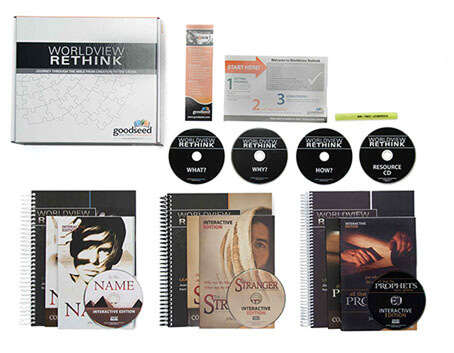
If this is the case, we recommend obtaining the Worldview Rethink course that is geared towards your student’s worldview. Complete with books, workbooks, DVDs and a leader’s guide, you will have all the tools you need to guide the student into a correct understanding of the Bible’s message. (If you are unable to decide which curriculum to use, default to using By This Name.)
Lien found that it was through By This Name that she was finally able to put all the puzzle pieces of the Bible together: “During that first winter break from college, those involved in the international dinners began a new study of a book called By This Name. This book gave a chronology and summation of the key events of the Bible, as well as an explanation of its message about Jesus Christ and how he came to provide salvation for mankind. That is when I finally connected the dots of those scattered Bible stories I had gathered over the years, resolving much of my confusion.”
You will need approximately 16 hours if you choose the By This Name curriculum (meant for all worldviews) and 12-13 hours if you choose The Stranger (Christianized worldview) or All the Prophets (Islamic worldview) curriculum.
Each worldview is sensitive to the students’ questions, providing objective and clear answers that naturally arise from that way of thinking.
The leader will use the leader’s guide which contains the full text of the coursebook, plus details on how to teach it, and a section of leader’s notes that goes deeper into the content. The leader will simply read the text. The student(s) will follow along in the coursebook and read the Bible verses.
At the appropriate sections, the leader can play the companion DVD for a richer learning experience. Using this format, even a new leader, or one who does not feel particularly gifted at teaching, will be able to guide their student to a clear understanding of the Bible’s message.
We often say “If you can read, you can lead.” Workbooks complement the teaching. Leaders can check students’ understanding using the workbooks which can be done at home or during the sessions.
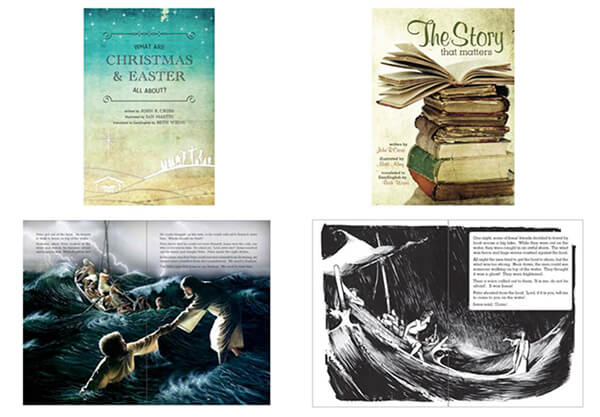
If this is the case, consider reading through one of two small booklets together with the student. This can easily be done in one sitting. Some have found it helpful to use What are Christmas and Easter All About? because those not familiar with these Western holidays are often curious as to their history. Others find the book The Story that Matters more suitable, not feeling tied to giving it away at certain holidays.
The content of both books are the same. The difference is in the style of the art. The Story that Matters has expressive line art that works well across all races and cultures. What are Christmas and Easter All About? has full-colour illustrations.
James and Shelly, who often lead studies with international students, have found these books very useful in reaching those for whom English is a second language. Often after reading through one of these short books, the students’ appetite is whetted and they will express interest in learning more. At this point, move to the first option above.
Often, students do with to deepen their Bible knowledge at this point. In this case, proceed to the option 1 using Worldview Rethink.
Both these booklets are written in easy-to-understand English and can be read aloud in less than an hour.
Read aloud the gospel story with your students, showing the illustrations as you go along. Pause and ask questions to ensure your listener is following along.
At the back of the booklets are two sets of questions. The first set checks for understanding while the second set checks to see what your listener believes. Use them where appropriate as you discuss the content with your student(s).
Give your students a copy of the book so they can review again for themselves or share it with their friends.
If the above options seem intimidating to you, then consider letting a gifted teacher take that burden for you. GoodSeed filmed John Cross as he taught the entirety of The Stranger on the Road to Emmaus, with segments filmed on-location in Israel, Egypt and Jordan. Just pop the DVD in, or view online for free.
Kevin and Seana, who volunteer with an international students’ ministry, have found this approach the most suitable for their needs. Kevin admits that he isn’t a great teacher and Seana agrees. Instead, they use The Stranger Videobook and let the DVDs do the teaching. The students then answer the workbook questions together as a form of review.
To help students further, Kevin gives each of them a copy of The Stranger or By This Name in their preferred language (where available) so they can read the message again for themselves. Kevin says that many of the students have understood and put their trust in Jesus.
This is an 11-hour video series. The six DVDs are divided into a total of 52 sections, ranging between 4 to 27 minutes each. In any given session you can watch as many or as few sections as you like.
You can watch the videos together and then discuss what was taught.
Use the accompanying workbook with your student. At the end of each video section, allow your student some time to fill in the workbook. This is a good way to check for their understanding. If they are unclear about a certain question, review the content again.
You may also choose to have your student fill in the workbook at home and the next time you meet, you review it together at the start of the session. Importantly, do not move on ahead until your student is clear on the content.
Often, along with studying through one of GoodSeed’s books in English, teachers find it helpful to give their student a copy of the book in the student’s native language. While studying the English version enables you to answer questions and encourages greater participation in the content, nothing quite compares to reading the message in one’s heart language.
Veronica found it helpful to have both an English and Korean copy of The Stranger as she taught a visiting Korean professor through the Bible’s message: “Because his English language skill was weak, having the Korean as well as English edition of the book was advantageous. He would read both before I came. When I arrived, he would already have many parts highlighted along with his questions. We would then talk through his questions about each chapter.”
See if your student’s native language is one of the many for which GoodSeed has produced a translation.
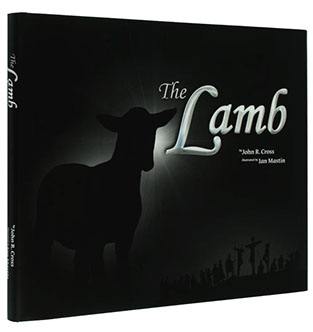
It takes two hours on average to read right through the book. Alternatives include reading through it all at once, doing it in two sittings or covering two chapters at a time over five sessions. Take care not to stretch out the time for too long or the story might become disjointed.
Read the book aloud, showing the full-colour illustrations to help you explain the gospel message.
Use the questions at the end of each chapter to check for understanding.
At the end of the book, allow the child or family member to assist in summarizing the story. You will be able to tell through the summary how much they have understood.
If appropriate, you can use the CD to reinforce the story. Even when you are not present, they can play it and listen to the story again. This can also assist in learning English.

As you move forward in your evangelistic endeavors, you will find it vital to make use of the body of Christ for support and encouragement. Here are some ways you can work together with other believers.
This is a great opportunity to both broaden as well as deepen your local church members’ understanding of the global world. There are numerous ways they can be involved:
Look for ways to link up with other campus ministries in order to strengthen and multiply the effectiveness of their outreach.
GoodSeed produces tools ideal for reaching international students, but often student ministries are unaware that these tools exist. Introduce the tools to them. You can also consider donating some resources to help them get started.
After your students have expressed faith in the work of Jesus on the cross, you cross the line from evangelism to discipleship. Your friendship with them is just as vital at this point as it was before they became believers. It’s important that you not leave the new believers to fend for themselves, but work to help them develop a deeper walk with the Lord. Here’s a few suggestions of next steps you can take:
Assist the students in obtaining their own copy of the Bible. Two copies would be great: one in English and the other in their heart language. Help them get started in reading it on their own. A great starting point is to read through By This Name, getting them to look up and read each Bible verse they come across in the book for themselves. The students will quickly become familiar with the Bible and will likely find themselves reading beyond the verses prescribed in the book.
Pray with your new brother or sister in Christ. Emulate for them how one can talk to God.
Bring other mature believers alongside them who can also encourage them in their faith. Fellowshipping and growing with other believers is an important aspect of the Christian walk. You might want to consider inviting them into your small group. Alternatively, you can start a small group with a mix of new and mature believers to model for them what good Christian fellowship is like.
Often we wish to invite friends seeking to know more about the Bible to our church. Make sure you give consideration to a few of the following factors as you prepare for this step:
Whether directly teaching international students the gospel message, or by supporting those who do, we can be sure our efforts will reach right around the world.
As we take advantage of the brief windows of opportunity to share the gospel and disciple these students while in our country, we can be sure they will take their new beliefs back to their home countries where they can be the most effective evangelists to their own people.
In the end, it is exciting to be a part of fulfilling God’s Great Commission—reaching the uttermost parts of the world, by reaching the world at our doorstep.
(* All names changed as per GoodSeed policy.)