
(Reading time: 14 minutes)
The “How to Train” series describes practical ways in which believers worldwide use our tools to share the message of the gospel.
In this article, we look at how you can use GoodSeed resources to share a clear gospel message with students learning English. It is meant both for formally trained English as a Second Language (ESL) teachers as well as believers who have opportunities to teach English at various informal settings.
The tried-and-tested advice in this article comes from three women who use GoodSeed materials in their English classes. Mari and Kate have a combined 25+ years of experience with ESL groups in their churches. Veronica has taught ESL to numerous individuals through her local university. Insightful suggestions gleaned from these women will enable you to effectively reach eager learners through the unique environment of the English as a Second Language class.
We also invite you to share your own experiences with us to benefit others. You can write to us via our contact form.
More than ever, the world is moving to our doorstep. One hundred years ago, there was basically one way to reach those in other countries. Missionaries climbed aboard heaving ships and sailed around the world, sometimes never to be seen again by their loved ones. They lived in foreign lands, mastering tongue-mangling languages and exotic cultures. They painstakingly translated God’s Word and shared the gospel.
While the overseas missionary is still a vital part of God’s plan in reaching the world with the gospel, more and more, God seems to be opening opportunities for his people to be directly involved in cross-cultural evangelism at home.
Not only are many coming to English-speaking countries, most need to learn English to navigate through life in their new country. The opportunities for sharing the gospel are no longer limited to those willing to learn a new language. Those we are seeking to reach are now eagerly desiring to learn English.
In addition, a number of these English learners come from countries where investigating the Bible is discouraged and even dangerous. While obstacles may still exist for some of them, they often feel greater freedom to examine other belief systems outside of their homeland.
God couldn’t be making it any “easier” for believers. This is a unique time in history, a unique opportunity to reach these English learners.

Those with a degree in ESL instruction will have formal options for teaching ESL students. But if you would like to teach on an informal basis, consider offering your services as an English tutor at a local library, literacy centre, refugee agency or through a university or college. Perhaps your church has an outreach to immigrants where you can minister by helping ESL students better grasp the language. Many certified ESL teachers appreciate volunteers coming alongside to give them a hand.
There will likely be a few predominant ethnicities in your area from which the majority of your ESL learners will come. Educate yourself about their home countries–the culture, belief system and the political/historical landscape that inform their worldview. Mari explains:
“This can be insightful and affects the way I frame certain topics that are introduced in our discussion.”
You must be sincere in your desire to help your student learn English, whether the student has any interest in the Bible or not. Therefore, you will need a good comprehensive English curriculum plan. If students feel they’re being tricked simply into being evangelized to a different faith, this will reflect badly upon you as the teacher, as well as upon the Lord. If you plan to use a gospel resource as part of the curriculum,
Mari suggests that the teacher be upfront. She says,
“If the purpose of the group is to share the gospel, be honest that this is a Bible study ESL class.”
The fact that you have an ESL learner means their grasp of any biblical truths you relate is going to be limited. When you have the opportunity to use Christian materials as part of your teaching strategy, Uncluttered by idioms and Christian phrases choose those that communicate the Bible’s truths simply and clearly, uncluttered by idioms and Christian phrases that are not easily understood by unbelievers.
Materials that the student can both listen to and read at the same time are even more helpful because they will not just learn the meaning but the pronunciation of the words.
An added advantage is finding the same book in both English and the student’s native language. This allows the student to compare and check his understanding as he learns English.
Mari gave some practical insights to remember as you dive into ESL teaching:
1. Keep the group size small. Mari finds four participants an ideal size for allowing discussion and reducing intimidation that comes with a larger group.
2. Don’t be afraid of silence.
“Language learners need time to process what has been said to formulate a response. It’s okay to have an entire minute of silence!”
“Some of the best questions and comments come just as I was about to break what seemed to be an interminable silence!”
3. Don’t do all the talking. Mari explains,
“Allowing plenty of opportunities for group members to engage allows me to understand what they are thinking and allows them to practice their English.”
4. Build relationship and trust. Mari has found it important to find other ways to be involved in her students’ lives and families.
“Genuine kindness and hospitality can go a long way to giving a face to the gospel.”
5. Pray! Mari rests on the fact that God is not bound by language or culture:
“Ultimately, it is the Spirit of God who will do the work in [the students’] hearts and break down the language barriers that sometimes make spiritual matters difficult to communicate.”

As an ESL teacher, your main goal is to help your students improve their English. If you are part of a church group offering English lessons, it may be easier to be upfront about using Bible study materials in the ESL class. However, this is not the only way to introduce Bible content into an English class.
Many teachers find that students, especially adult learners, quickly tire of the monotonous content of the materials used to help them learn. In addition, some students are curious and want to learn more about the culture, customs and beliefs of their adopted country. It is not unusual for the student to inquire about the beliefs of his or her teacher, which creates a natural bridge to conversation regarding the Bible’s message. Even when it is the teacher who suggests looking at the Bible, students do jump at the opportunity to learn something a little more engaging.
Kate wrote us about her 17 years of experience in this particular area:
“Many of the internationals we meet in our English language classes have no Bible background. In addition to the desire to improve their conversational English, there is often a strong interest in learning about the Bible.”
Veronica shared her example.
“[I teach] ‘Conversational English.’ That’s usually what they want: someone to talk with about common, everyday things. We start with that for a few weeks until they get bored. We’ll talk about plants, food, children, culture, holidays until they begin to get tired with that. For example, when a professor—who is now a believer—first came, all he wanted to talk about was his religion and food. For six weeks he talked about vegetables. I did my best to hide my boredom.
“Finally he said, ‘Veronica, this is boring.’ I agreed, ‘Yeah, you’re right. Let’s talk about something else.’ He immediately changed the subject and asked, ‘Veronica, can you tell me the difference between religion and faith?’ So many times it will be a big question like that that will open up the door.”
When we desire to walk with people, we must be committed to wading through the mess with them. The people we befriend may have habits we find distasteful. Perhaps our friend is a heavy drinker or uses foul language. Or like Dennis, we may have to listen to hours of empty talk before enough trust is established and our friend begins to open up on the deeper struggles and questions about life.
“Being a friend of the worldis compromise;being a friend of sinnersis compassion.”
It’s important to realize there is a big difference between being a friend of the world and being a friend of sinners. Dennis explained, “Being a friend of the world is compromise; being a friend of sinners is compassion.”
Those around us need to clearly see we are different, but they also need to know we love them and care about them, right in midst of the life’s messiness.
Veronica went on to say,
“Typically I don’t have to bring up the subject but they will start asking questions after they’re feeling comfortable with me. Either they ask, ‘Veronica, would you please teach me the Bible?’ or I might say: ‘You know, we’ve been studying English for quite a while and I can tell you’re kind of bored. Let’s have a Bible study. It is really interesting. If you enjoy doing that, we can continue with the Bible or we can stop—it will be up to you.’”
When your student has indicated that he or she desires to know more about the Bible, take it as a wide-open invitation to explain the Bible’s main message.

Over the years, we have received correspondence from different teachers in ESL settings sharing with us their preferred GoodSeed resource.
FOR BEGINNER OR INTERMEDIATE STUDENTS

What are Christmas and Easter All About? and The Story that Matters are two popular GoodSeed books that have been used to great effect with ESL learners. The content in both are the same. The difference lies in the titles and artwork. One is fully illustrated while the other uses expressive line art. Both offer unique strengths in a number of areas:
1. They are written in simple English for those with minimal English comprehension. The author intentionally used a limited vocabulary and simple sentence structures to communicate the Bible’s message.
2. They do not use confusing idioms or metaphors, and no Christian jargon is used to explain Bible truths. When unfamiliar words are introduced, they are immediately defined for the reader.
3. The books assume nothing in the understanding of the reader, so even a student completely unfamiliar with the Bible’s message can follow the message laid out in these books.
4. They contain review questions to gauge the comprehension of the learner.
Mari explained the benefits of Christmas & Easter:
“It is at a very accessible language level [for my intermediate learners]. This allows us to focus on discussion of the meaning… rather than spending all our time deciphering the English.”
Depending on the reading ability of your students, you can either read the book to them, get them to read it or take turns reading through the book. How far you get in each lesson depends upon their understanding. Be flexible and willing to go with the flow, pacing the material to match your students’ comprehension.
Mari took this one step further. She asked for permission to make a recording of her reading Christmas & Easter so her students could listen at home. She shared,
“Each week we cover a few pages of the book. They listen to the recording [I made] at home during the week prior to the lesson… It’s been a good resource for them to practice pronunciation. Some even download the excerpts to their devices to listen to while they’re commuting. Since giving them… the audio recordings, I have noticed their pronunciation has greatly improved.”
..the books have the effect of…whetting the students’ appetite…
Often the books have the effect of simply whetting the students’ appetite and creating a desire for more information. Mari has found that while they grasp the content well, they don’t seem to understand at this point that the message applies to them personally. She senses, however, that “they are intrigued.”
Veronica finds that many students want to continue learning about the Bible after that.
“They always say, ‘I didn’t know the Bible was this much fun or was so interesting! Let’s do more!’”

The Lamb has also been used effectively in many ESL situations. Originally written for children, the simple language and fully illustrated art makes the message accessible for the ESL learner. Teachers like The Lamb because it has an optional audio book that allows the student to read and listen to the message at the same time. It also has review questions after each chapter to enable both teacher and student to check for comprehension.
Additionally, the availability of different translations means that the learner can read the material in English and then check their comprehension in their native language.
Have the student read a few pages of The Lamb out loud each session, then go over the review questions to check for comprehension. The student can then practice at home by reading and listening to the CD or online streaming.
Kate wrote:
“We welcome the opportunity to teach Bible studies but this usually takes a lengthy period of time to get the full picture. With The Lamb, we are now able to begin with a quick picture of the basic message of the Bible for adults as well as children. As they then continue their studies, it will make sense in the context of the broad picture presented in The Lamb.”
FOR MORE ADVANCED ENGLISH STUDENTS
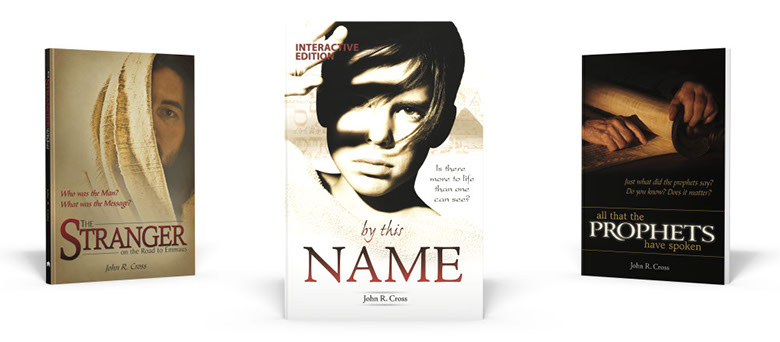
Veronica finds that many students want to continue learning about the Bible after going through one of the simpler GoodSeed books.
“They always say, ‘I didn’t know the Bible was this much fun or was so interesting! Let’s do more!’ If that continues for a few times, I bring out The Stranger on the Road to Emmaus and ask, ‘Would you like to go through this?’ And they’ll respond, ‘Oh, I’d love to do that!’”
By This Name, All that the Prophets have Spoken and The Stranger on the Road to Emmaus give a much more thorough presentation of the gospel.
By This Name is our premier book. It engages those who hold to their own version of spirituality, made up of many differing beliefs. It also speaks to those who think of God as an impersonal force and those with post-modern, post-Christian, or secular mindsets. It addresses questions arising from polytheism, pantheism, animism, agnosticism and atheism.
All that the Prophets have Spoken is tailored to address the Muslim worldview.
The Stranger on the Road to Emmaus was written for those with a Christianized worldview, where they would think in terms of God being a person (in contrast to an impersonal force) and have a somewhat biblical concept of sin.
If your students wish to move on to deeper information, consider using one of the above books within the Worldview Rethink curriculum. These come complete with a teacher’s guide, student book and workbook, as well as accompanying video clips that further explain the material. In addition, you have the option of using numerous visual aids, which are ideal for teaching abstract concepts to ESL learners.
Additionally, the availability of different translations means that the learner can read the material in English and then check their comprehension in their native language.
Depending upon the background and worldview of your student, choose the most appropriate book from the Worldview Rethink curriculum. If you choose to use this curriculum, it is very important that your student commit to meeting several hours each week so the material can be covered in a relatively short period of time. This ensures your student will not lose the continuity of the Bible’s message. Taking too long a time to cover the content would be akin to watching a two-hour movie over several months. The continuity and clarity of the message would suffer.
Simply sit down with your student and read through the book. You can read the commentary while your student reads the verses. You can watch the video clips together or you may choose to also use the visual aids when prompted in your leader’s guide. Upon completing each section, take some time to go over the review questions in the workbook and make sure any areas of confusion are addressed.
FOR STUDENTS WITH HIGHER LISTENING VERSUS READING ABILITY
Occasionally, you may have an ESL learner with very little English ability. Often in such cases, the student’s ability to comprehend is stronger than their ability to speak the language. In these cases, if you are using a book, you may have to do the majority of the reading, moving slowly through the material and reviewing often.
Veronica did this with a Korean couple:
“Right now I’m going through The Stranger with another couple. Their English ability is quite minimal; they cannot read well. So, I read the book aloud, sometimes using a children’s picture Bible, telling the story as we progress through The Stranger story line. This Easter they understood for the first time what the death and resurrection of Jesus Christ was all about. The wife just told me, ‘Now I understand that man is completely sinful and there is nothing worse on this earth than sinful man and that Jesus is the Lamb of God who made the sacrifice to take away the sins of the world and they were all put on him.’”
Various Translations

Often your student will need to go over the Bible’s message several times before comprehension begins to sink in. Being able to read essentially the same message in their native tongue can be a big help in this area.
Check out the list of available translations to see if a book is available in the heart language of your student. Some teachers have found it helpful to use both the English version and its translation at the same time.
Veronica has found this approach helpful on occasion. She shared one example:
“I’ve just finished going through The Stranger on the Road to Emmaus with a visiting Korean professor at our university. Because his English language skill was weak, having the Korean as well as the English edition of the book was advantageous. He would read both before I came. When I arrived, he would already have many parts highlighted along with his questions. We would then talk through his questions about each chapter… He is now a solid believer and has already talked to his next-door neighbour, who also happens to be a visiting scholar from Korea. His wife wants to start studying the Bible, as well.”
The Stranger Videobook

Another alternative is to use The Stranger Videobook. This relies more on your student’s listening comprehension than reading. You can watch each section together and then discuss the content taught.

We hope that you find some of these experiences of how ESL teachers have shared the gospel useful. As you prayerfully approach these opportunities, trusting that God will work to help your students in their understanding, do keep in mind that there are often some delicate cultural expectations your students may have to navigate as they consider their response to the gospel.
Give your students time and space… to count the cost.
When your students’ family relationships, community and even their safety are at risk, making the choice to become a Christian is not one made lightly. Give your students the time and space they need to count the cost of choosing Christ.
Veronica shared one last story:
“Several years ago, a Law professor from one of the Asian countries was here… He was curious about the Bible and we began going through The Stranger in a Sunday School class.
“At that time, he enjoyed it very much but he was also resisting it. He finally said, ‘I can’t believe this because if I go back [home], they’ll fire me from my job and put me in prison the rest of my life.’ He returned home quite conflicted. I thought that I would never see this man again but I prayed for him…
“Then all of a sudden, [four years later], I got an email that he was back in town. He said, ‘I’ll be in church first thing Sunday morning. I want to start our study again. I’ve never forgotten what you taught me about the Bible and I want to look at it again––although I can’t believe it.
“For several weeks he kept saying, ‘I can’t believe it, I can’t believe it… but I just want to learn it.’ About a month ago, as we were making our way at a slower pace through The Stranger, he said, ‘I am beginning to change––I am beginning to believe.’ So we’re praying for that man. He is inviting everyone whom he meets to come to the study. Just this weekend, he said, ‘Veronica, let’s start having dinner parties on the weekends. I’ll invite the people, you be prepared and we’ll ask you questions about the Bible after we eat… because this is really good stuff.’”